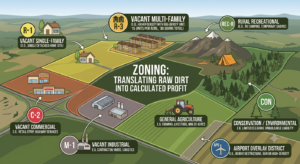
To bring this all squarely back into our world of vacant and rural land investing, we have to look at zoning entirely through the lens of an acquisition and disposition strategy. As land investors, we aren’t building these structures ourselves; we are looking at raw dirt and evaluating what a future buyer can legally build on it.
When you look at vacant land, standard zoning definitions change. A commercial zone isn’t a building; it’s a premium exit strategy. An open-space zone isn’t a beautiful park; it’s an unbuildable liability.
Here is the deep-dive guide to looking at raw, vacant acreage and translating county zoning codes into raw profit or hidden risk.
1. Vacant Residential Zoning: Single-Family vs. Multi-Family Dirt
When buying vacant residential lots, our primary metric is density and minimum square footage requirements.
Vacant Single-Family (R-1 / SFR)
What it actually is: This zoning code designates the raw land exclusively for a single, permanent, detached residential home. It outlaws any commercial activity, multi-family units, or industrial uses, and heavily regulates the physical footprint of the future house via strict setbacks from property boundaries.
Qscapital Angle: Look out for “minimum build sizes.” A county might zone a vacant lot for residential use but mandate that any home built must be at least 1,500 square feet. If we are selling to a buyer who wants to build a small 600-square-foot cabin or an off-grid tiny home, this zoning requirement completely kills our sale.
Vacant Multi-Family (R-2, R-3)
What it actually is: This classification earmarks the dirt for high-density residential development, legally allowing structures like duplexes, triplexes, townhomes, or multi-story apartment buildings. It is explicitly designed by the county to pack more housing units into a single acre of land.
Qscapital Angle: Developers evaluate multi-family vacant land on a “per-door” basis. If we find a vacant 2-acre parcel zoned R-3 that allows 15 units per acre, we aren’t selling a piece of dirt—we are selling the legal right to build 30 units. This zoning exponentially increases our exit price compared to a standard single-family lot.
2. Vacant Commercial & Industrial Land: Infill vs. Highway Tracts
Buying raw commercial or industrial land requires looking strictly at transit infrastructure, access, and environmental history.
Vacant Commercial (C-1, C-2, CH)
What it actually is: This code earmarks the raw dirt for consumer-facing businesses, retail storefronts, offices, and service stations. It usually features strict requirements for public access, high traffic capacity, and visible road frontage, while carrying significantly higher annual property tax rates than residential or agricultural dirt.
Qscapital Angle: Vacant commercial lots are highly sensitive to location. A raw lot zoned Highway Commercial (CH) right off an interstate exit is prime for a gas station, truck stop, or fast-food chain. However, if the county zoned a piece of raw land “Commercial” but it sits deep down a bumpy dirt road with no utilities, that zoning actually hurts us. It increases our property taxes significantly while remaining completely unusable to actual commercial developers who require high-visibility traffic counts.
Vacant Industrial (M-1, M-2)
What it actually is: This zoning designates the land for heavy-utility, non-consumer commercial use—specifically manufacturing, long-term warehousing, assembly lines, and freight distribution. It is intentionally placed far from residential neighborhoods to isolate heavy truck traffic, noise, and potential environmental emissions.
Qscapital Angle: Raw land zoned for Light Industrial (M-1) is highly sought after today for boat/RV storage yards, contractor yards, and small fulfillment warehouses. Because these uses require minimal infrastructure beyond a cleared lot, gravel, and a fence, it is a highly liquid asset class for raw land flippers.
3. The Giants: Vacant Agricultural and Resource Land
This is where the vast majority of rural land investors operate. When dealing with large acreages, the zoning code entirely dictates our ability to flip or subdivide the asset.
General Agriculture (A-1 / AG)
What it actually is: Designed to protect rural economies, this code restricts the raw dirt to farming, crop cultivation, livestock grazing, and timber production. While it usually permits a single primary farmhouse, its primary intent is to stop residential subdivisions from eating up rural, working farmland.
Qscapital Angle: The ultimate trap here is the Minimum Lot Size requirement. If we buy a vacant 40-acre agricultural tract intending to cut it into four 10-acre parcels and sell them to individual buyers, we must check the county’s AG threshold first. If the county’s minimum lot size for agricultural zoning is 20 acres, our 10-acre subdivision plan is illegal by-right, and we will get stuck holding the entire 40-acre block.
Forestry, Timber, and Conservation (F / CON)
What it actually is: This classification applies to raw land located in ecologically sensitive areas, thick forests, or watersheds. The county uses this code to preserve natural resources, legally restricting or completely banning permanent residential builds while regulating how many trees can be harvested or cleared from the dirt.
Qscapital Angle: Raw land zoned for forestry or conservation often carries severe clearing restrictions. We or our buyers might buy a gorgeous wooded lot only to find out that county environmental rules state you can only clear 5% to 10% of the native vegetation for a building footprint. The rest must remain untouched, severely limiting the usability of the acreage.
4. Advanced Play: Vacant Mixed-Use & PUDs
Vacant Mixed-Use (MU) & Planned Unit Developments (PUD)
What it actually is: Rather than segregating uses, this zoning provides a flexible, custom framework. For mixed-use, it legally allows commercial storefronts and residential apartments to occupy the exact same parcel. For a PUD, it represents a highly specialized, custom-negotiated blueprint where the county grants unique density and setback rules for a specific master-planned development.
Qscapital Angle: If we come across a large, vacant parcel that is already part of a PUD or zoned for Mixed-Use, we are looking at a highly sophisticated asset. A PUD means the land has a customized rulebook already negotiated with the local government. For our strategy, this means the expensive, time-consuming structural planning work has already been done, making it incredibly attractive to regional homebuilders or commercial developers looking for shovel-ready projects.
The Ultimate Vacant Land Rule: In raw land investing, zoning creates the ceiling for your property’s value. Never buy a parcel based on what it looks like it can be used for; buy it strictly based on what the county’s Land Use Ordinance legally permits the dirt to become.